 RED WINE
  ROSÈ WINE
  WHITE WINE
  ORANGE WINE
  SWEET WINE
  SPARKLING WINE
  CHAMPAGNE
  SPARKLING
  SPARKLING
  SPARKLING
.jpg) LA STOPPA
LA STOPPA.jpg)
.jpg)
 DOMAINE BALLORIN
Producer
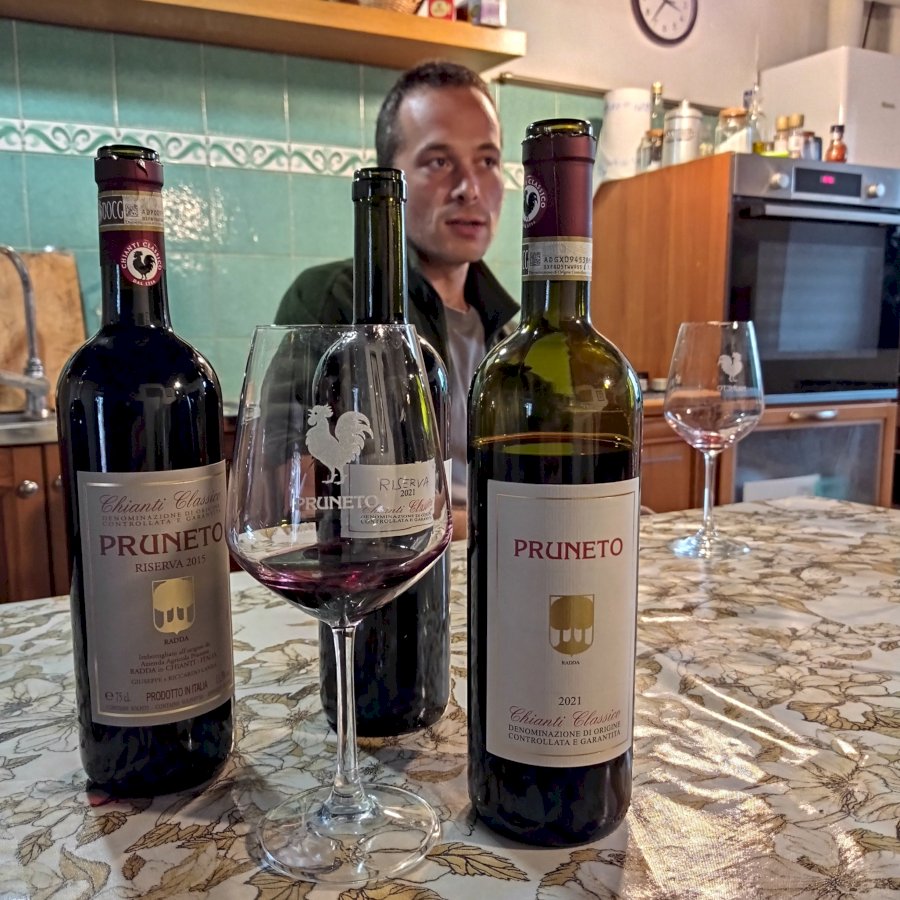
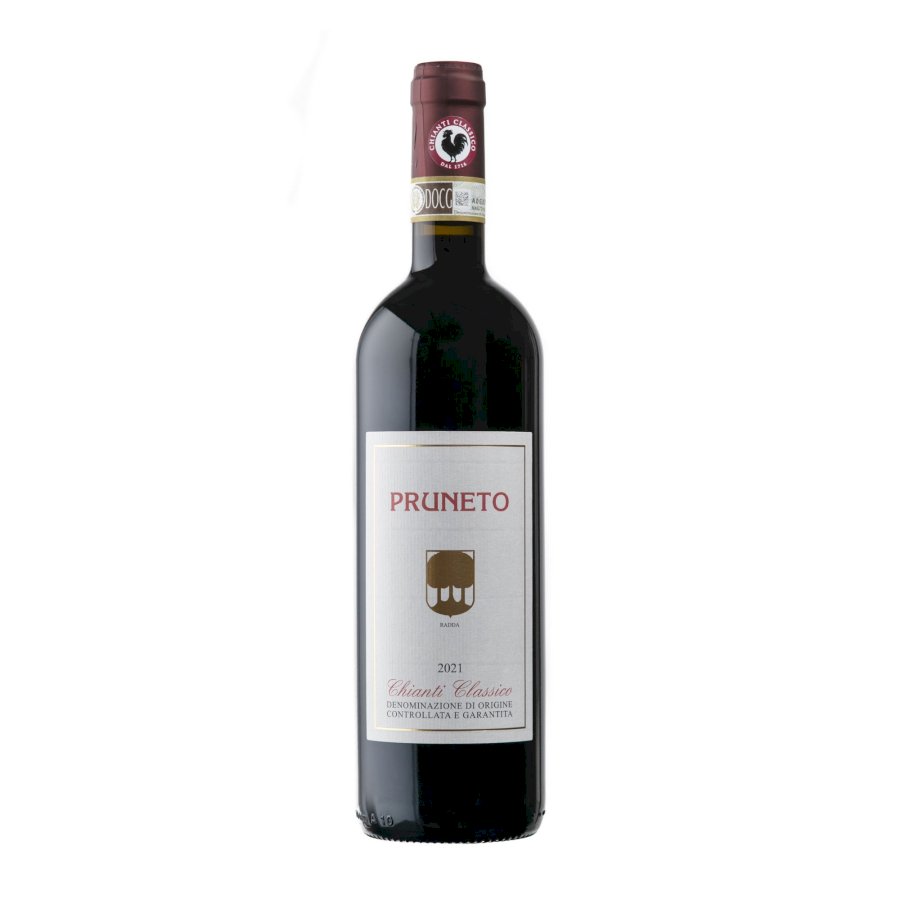
Pruneto

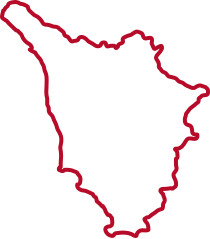

Italy, Tuscany
Radda in Chianti, Siena
Radda in Chianti, Siena
 13000 bottles in the cellar
 Specialities: Red wine
We are located in Radda in chianti, the Pruneto estate built in the second half of the 1700s, is situated on the crest of a hill in a breathtaking setting of nature and landscape. In this particular area of Chianti, woodland still predominates, about 75 percent over vineyards and olive groves, which in itself is an extraordinary fact, and one understands the important biological diversity of these historically wild lands.
The estate was purchased by the Lanza family in the 1960s and converted to a farm in the early 1970s'. The first bottling was in 1981.
Massimiliano, who represents the third generation of winemakers, tells us how the vineyards cover just over three hectares, arranged along the southern slope of the hill on which the farm rests, with southern and southwestern exposure. A single body divided into 3 plots: the first planted in 1972 in the upper part with purely sandy soil where the Sangiovese for the reserve comes from , the second from 1999 in the lower part, where the clay part is prevalent and the grapes express character and power and finally a vineyard that connects the previous ones planted in 2017.
The predominant grape variety is obviously Sangiovese, flanked by a few rows of Merlot, Canaiolo and Ciliegiolo.
Work is based on simplicity and highest attention
All work on the vines is done manually, from pruning to harvesting. The vines are trained using the espalier system: double spurred cordon, Guyot and traditional Tuscan bow. In the inter-row, sown soils alternate with spontaneously grassed soils, so as to preserve plant biodiversity, provide agronomic support for the microbiological viability and nutrition of the vines, and greater resistance to runoff and erosion.
The few treatments involve only the use of non-synthetic and organically approved products. Fertilizations are carried out every 3-4 years with earthworm humus.
In thewinery, minimal intervention winemaking is preferred , with no use of ingredients other than grapes and modest amounts of sulfur dioxide. Fermentations are spontaneous and no filtrations or clarifications are performed.
Cement and steel tanks are used for vinification, while 30 hl oak barrels and a few spent barriques are used for aging.
Real wines that mirror these places: deep, even austere but with great personality and elegance.